
Artificial Intelligence has become one of the most transformative technologies in human history. In 2026, AI is no longer viewed simply as a productivity tool or a futuristic innovation reserved for large tech companies. It has become a deeply integrated part of everyday life, influencing how people think, work, communicate, design, write, create, and innovate.
From digital artists generating breathtaking visual masterpieces using AI-powered design systems to writers producing high-quality content with advanced language models, the relationship between humans and machines has evolved rapidly. The world is witnessing a new creative revolution where human imagination and artificial intelligence are working together to reshape the future.
The discussion around How AI is Changing Human Creativity has become one of the most important conversations in technology, education, business, entertainment, and culture. Many people once feared that AI would replace artists, writers, musicians, and designers. However, the reality unfolding in 2026 is far more complex and exciting.
Instead of destroying creativity, AI is expanding creative possibilities.
Artificial Intelligence is helping creators explore ideas faster, produce higher-quality work, automate repetitive tasks, and unlock new forms of artistic expression that were previously impossible. At the same time, human creativity remains the emotional and intellectual force behind meaningful storytelling, innovation, and authentic expression.
In this in-depth guide, we will explore exactly how AI is changing human creativity in 2026, including its impact on writing, design, music, filmmaking, education, marketing, innovation, and the global creative economy.
Table of Contents
- Introduction to AI and Human Creativity
- Understanding Creativity in the AI Era
- How AI is Changing Human Creativity in Content Writing
- AI and the Evolution of Graphic Design
- The Transformation of Music and Video Production Through AI
- How AI is Revolutionizing Creative Business Innovation
- The Psychological Impact of AI on Human Creativity
- AI-Powered Productivity for Modern Creators
- Ethical Concerns Around AI Creativity
- Human Creativity vs Artificial Intelligence
- Industries Most Affected by Creative AI
- Future Trends in AI and Creativity
- Best AI Tools for Creative Professionals in 2026
- Why Human Creativity Will Always Matter
- Final Thoughts
- Frequently Asked Questions
Introduction to AI and Human Creativity
Creativity has always been considered one of the most unique and powerful aspects of human intelligence. For centuries, people believed creativity was something deeply personal — an ability connected to emotions, experiences, imagination, and consciousness.
Artists painted masterpieces inspired by their emotions. Writers crafted stories from personal experiences. Musicians composed songs that reflected human struggles, love, hope, and pain.
Then Artificial Intelligence entered the conversation.
What once seemed impossible is now becoming normal. AI systems can now:
- Generate realistic artwork
- Write complete blog posts
- Compose music
- Create videos
- Build marketing campaigns
- Design products
- Generate business ideas
- Produce cinematic animations
This dramatic shift has completely changed the global perception of creativity.
Today, the question is no longer whether AI can contribute creatively. Instead, people are asking:
How AI is Changing Human Creativity and what role humans will play in the future of creative work?
The answer lies in collaboration.
AI is not replacing the human mind. Instead, it is acting as a powerful assistant that enhances creative workflows, improves efficiency, and allows creators to focus more deeply on strategic and emotional thinking.
The most successful creators in 2026 are not the people avoiding AI. They are the people learning how to use AI intelligently while maintaining originality and authenticity.
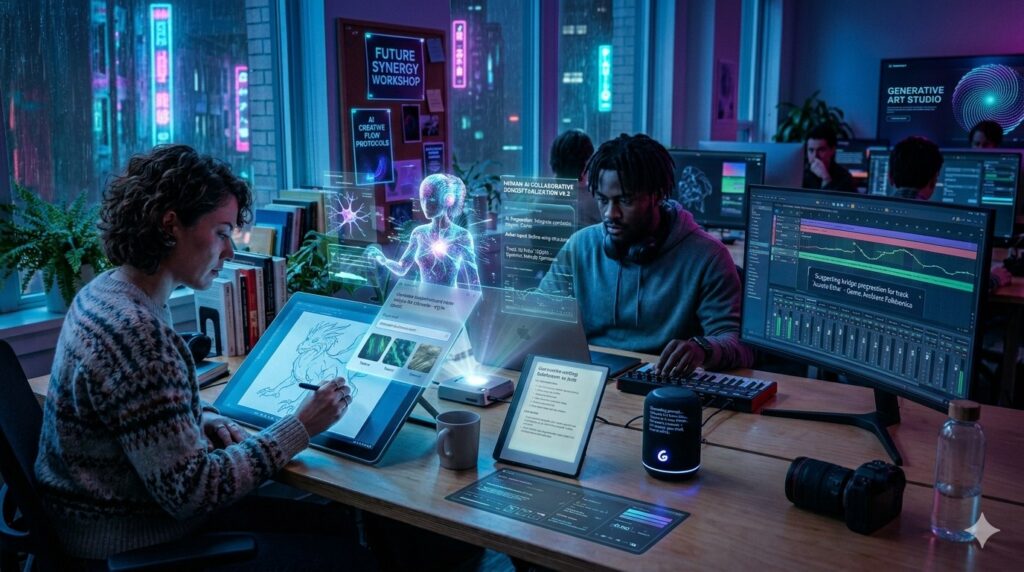
Understanding Creativity in the AI Era
To understand how AI is changing human creativity, we first need to redefine what creativity actually means in 2026.
Traditionally, creativity was associated with:
- Artistic talent
- Manual skills
- Original ideas
- Imagination
- Human emotion
However, modern creativity now includes:
- Digital innovation
- AI collaboration
- Interactive storytelling
- Data-driven design
- Personalized content creation
- Cross-platform experiences
In today’s world, creativity is no longer limited to painters, writers, or musicians. Entrepreneurs, marketers, developers, educators, and business leaders all rely heavily on creative thinking.
AI has expanded creative opportunities by making advanced tools accessible to millions of people worldwide.
For example:
- A beginner can now create professional graphics using AI design software.
- A solo content creator can produce cinematic videos without a large production team.
- Small businesses can compete with global brands using AI-powered marketing strategies.
This democratization of creativity is one of the most revolutionary developments of the digital age.
Artificial Intelligence is lowering technical barriers while increasing creative possibilities.
How AI is Changing Human Creativity in Content Writing
One of the most noticeable examples of how AI is changing human creativity can be seen in content writing and digital publishing.
In 2026, AI writing assistants have become incredibly advanced. They can generate:
- Blog posts
- Website copy
- Product descriptions
- Social media captions
- Video scripts
- Email marketing campaigns
- SEO articles
- Business reports
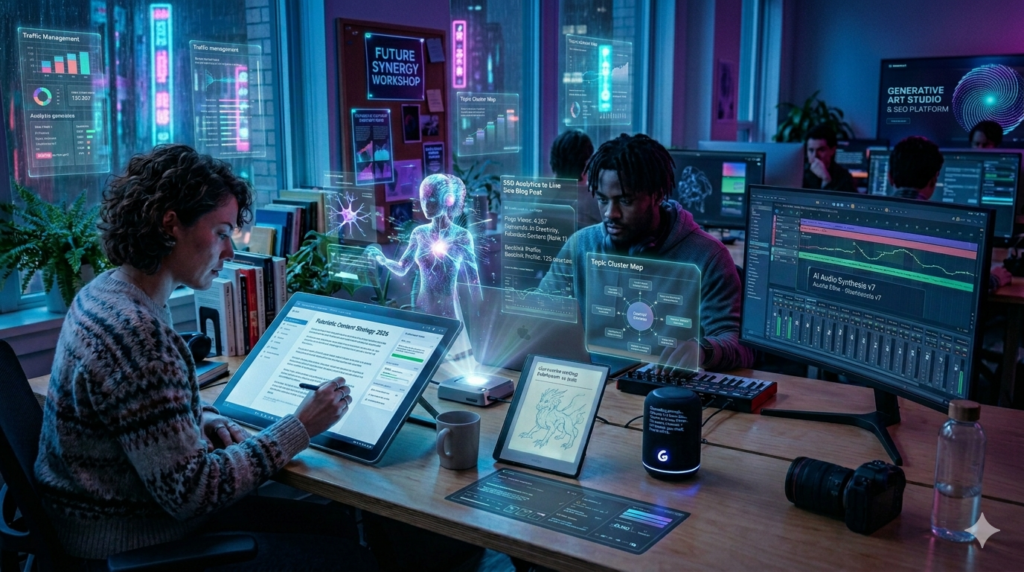
Content creators now use AI tools to brainstorm ideas, structure articles, improve grammar, optimize SEO, and accelerate research processes.
However, while AI can generate words quickly, it still lacks genuine human experiences and emotional understanding.
That is why the best-performing content online is still created through a combination of:
- Human storytelling
- Emotional intelligence
- AI-powered efficiency
- Strategic SEO optimization
Professional writers use AI to remove repetitive tasks while focusing their energy on creativity, narrative depth, audience engagement, and authentic communication.
For example:
- AI can generate article outlines in seconds.
- AI can suggest SEO-friendly headlines.
- AI can improve readability and keyword placement.
- Humans then add personality, expertise, emotional depth, and originality.
This partnership between human creativity and machine intelligence is transforming digital publishing at an unprecedented scale.
Platforms such as OpenAI continue to develop advanced AI systems that support writers and businesses worldwide.
AI and the Evolution of Graphic Design
Graphic design has undergone one of the biggest technological transformations in recent years.
Before AI, creating high-quality visual content required years of technical experience and expensive software expertise. Today, AI-powered design platforms allow creators to generate stunning visuals within minutes.
Modern AI design tools can:
- Generate logos instantly
- Create social media graphics
- Produce digital paintings
- Edit photos automatically
- Generate branding concepts
- Create realistic illustrations
- Remove backgrounds intelligently
- Upscale low-quality images
This technological advancement demonstrates exactly how AI is changing human creativity in visual communication.
However, professional designers are still incredibly valuable because AI cannot fully understand:
- Brand identity
- Cultural meaning
- Emotional storytelling
- Human psychology
- Artistic intention
AI can generate design variations rapidly, but humans still guide the creative vision behind meaningful visual experiences.
Companies such as Adobe have integrated AI deeply into their creative ecosystems, helping designers become more productive while preserving artistic control.
The future of graphic design is not human versus AI.
The future is AI-enhanced human creativity.
The Transformation of Music and Video Production Through AI
Music and video production are evolving faster than ever before due to AI-powered technologies.
In 2026, AI tools are helping creators:
- Edit videos automatically
- Generate cinematic transitions
- Create subtitles instantly
- Remove background noise
- Generate voiceovers
- Compose music
- Enhance visual effects
- Produce realistic animations
Independent creators who once lacked financial resources can now compete with large production studios.
For example:
- YouTubers can create professional-quality videos with minimal editing knowledge.
- Podcasters use AI audio enhancement tools for studio-level sound quality.
- Musicians experiment with AI-generated melodies and harmonies.
- Filmmakers use AI for advanced visual effects and scene generation.
This democratization of creative production is empowering millions of people worldwide.
Yet emotional storytelling remains deeply human.
People connect emotionally with stories, experiences, struggles, dreams, and authentic perspectives — qualities AI cannot truly experience.
This balance between technology and emotional authenticity perfectly explains how AI is changing human creativity without eliminating human value.
How AI is Revolutionizing Creative Business Innovation
Businesses in 2026 are increasingly dependent on creative innovation to survive in highly competitive digital markets.
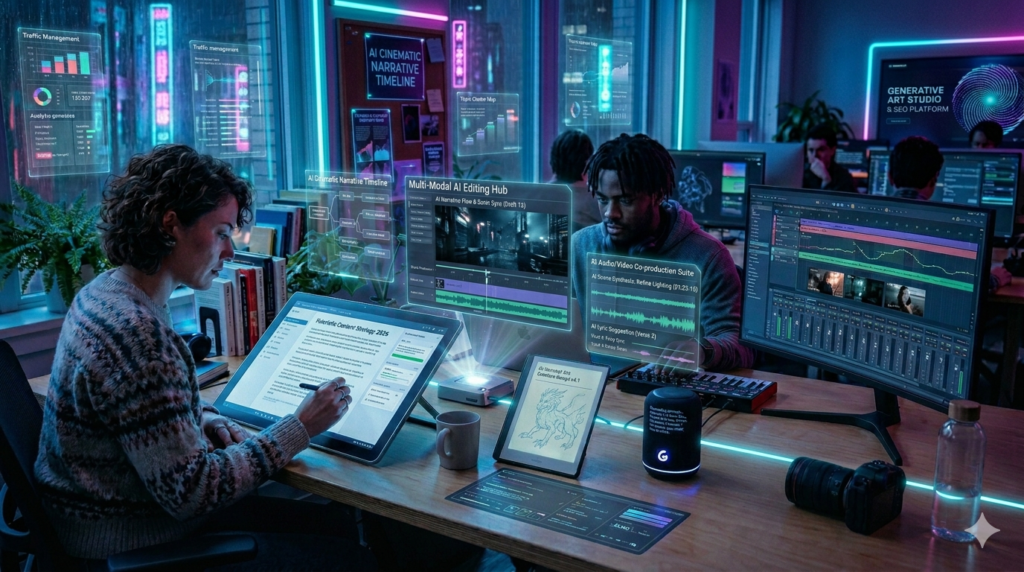
AI is transforming business creativity by helping companies:
- Generate marketing ideas
- Predict consumer behavior
- Create personalized advertisements
- Develop branding strategies
- Design products faster
- Analyze customer preferences
- Automate content production
Modern businesses use AI to improve both efficiency and creativity simultaneously.
This is one of the most important aspects of how AI is changing human creativity in the corporate world.
AI allows businesses to process enormous amounts of market data quickly, helping brands make smarter creative decisions.
For example:
- E-commerce companies personalize product recommendations using AI.
- Marketing agencies generate multiple ad concepts instantly.
- Brands create AI-powered customer experiences tailored to individual users.
Organizations that successfully combine human creativity with AI-powered analytics are gaining significant competitive advantages.
Research and innovation platforms like MIT Technology Review regularly highlight how AI is reshaping industries and global innovation systems.
The Psychological Impact of AI on Human Creativity
The rapid growth of AI has also created psychological changes in how people perceive creativity and self-worth.
Some creators feel empowered by AI tools because they:
- Reduce creative burnout
- Accelerate workflows
- Inspire new ideas
- Increase productivity
Others fear:
- Job displacement
- Loss of originality
- Creative dependency
- Reduced artistic value
These emotional reactions are understandable because creativity has always been deeply connected to personal identity.
However, history shows that technology often transforms creativity rather than destroying it.
Photography did not eliminate painting.
Digital music did not eliminate musicians.
The internet did not eliminate writers.
Similarly, AI is unlikely to eliminate creativity altogether.
Instead, it is forcing creators to evolve.
People who adapt creatively to AI technology will likely discover new opportunities, careers, and forms of artistic expression.
AI-Powered Productivity for Modern Creators
One of the greatest benefits of AI is productivity enhancement.
Creative professionals in 2026 use AI to automate repetitive tasks so they can focus more deeply on strategic and imaginative work.
AI improves:
- Time management
- Research efficiency
- Workflow organization
- Idea generation
- Creative experimentation
Freelancers and entrepreneurs particularly benefit because AI allows smaller teams to produce high-quality work at scale.
For example:
- A solo entrepreneur can manage content marketing using AI.
- A freelance designer can generate multiple concepts rapidly.
- A video creator can automate editing workflows.
This increased efficiency allows creators to spend more time on:
- Innovation
- Emotional storytelling
- Brand development
- Audience engagement
This practical transformation is another powerful example of how AI is changing human creativity across industries.
Ethical Concerns Around AI Creativity
Despite its enormous advantages, AI also introduces serious ethical concerns.
Some of the biggest issues include:
Copyright and Ownership
Who owns AI-generated content?
The human creator?
The AI company?
Or both?
This remains a major legal debate globally.
Deepfakes and Misinformation
AI-generated videos and voices can be manipulated to spread false information or impersonate individuals.
Creative Authenticity
Some critics argue that excessive AI usage may reduce originality and produce repetitive content.
Job Displacement Concerns
Many professionals worry about automation replacing traditional creative jobs.
Data Privacy
AI systems often rely on enormous datasets, raising concerns about privacy and ethical data usage.
Understanding these challenges is essential when discussing how AI is changing human creativity responsibly.
Ethical AI development will play a critical role in shaping the future of digital creativity.
Human Creativity vs Artificial Intelligence
One of the most debated topics today is whether AI can truly replace human creativity.
The reality is that AI and humans operate very differently.
AI excels at:
- Data analysis
- Pattern recognition
- Automation
- Speed
- Large-scale content generation
Humans excel at:
- Emotional understanding
- Personal experiences
- Cultural interpretation
- Intuition
- Conscious storytelling
- Meaningful artistic expression
AI does not experience love, pain, fear, ambition, nostalgia, or human relationships.
Humans do.
That emotional depth remains the foundation of powerful creativity.
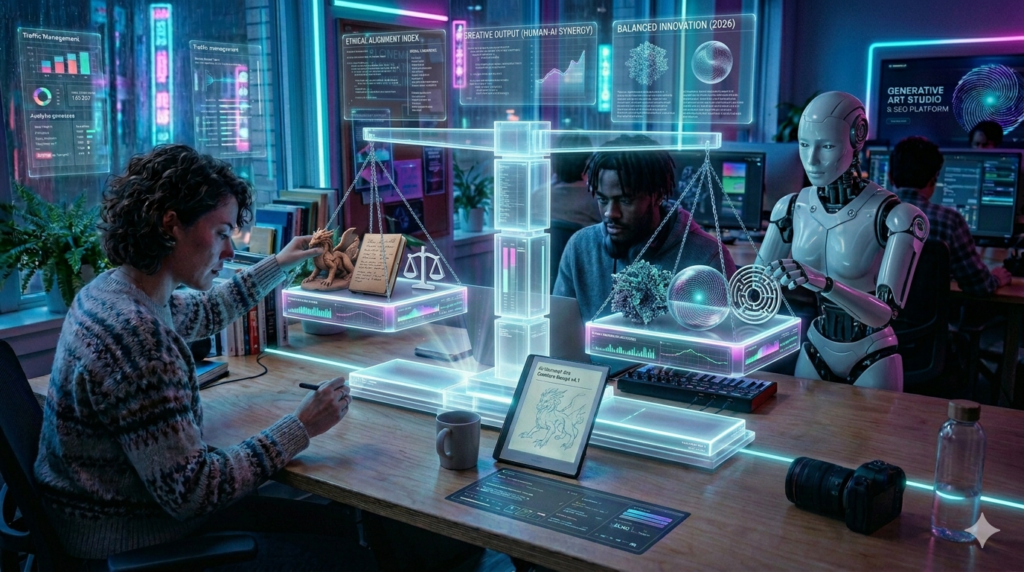
The future of innovation is not about humans competing against AI.
It is about humans using AI intelligently to amplify imagination and productivity.
This partnership represents the true future of how AI is changing human creativity worldwide.
Future Trends in AI and Creativity
The next decade will likely introduce even more advanced forms of human-AI collaboration.
Future creative trends may include:
- AI-generated virtual worlds
- Personalized entertainment experiences
- Interactive storytelling systems
- AI-powered filmmaking
- Hyper-realistic digital influencers
- Real-time creative collaboration tools
- Immersive augmented reality experiences
Educational institutions are also adapting rapidly.
Schools and universities are beginning to teach students:
- AI-assisted creativity
- Digital innovation
- Prompt engineering
- AI content strategy
- Human-centered storytelling
The creators who succeed in the future will be those who understand both technology and human psychology.
Best AI Tools for Creative Professionals in 2026
Here are some of the most powerful AI tools used by creators in 2026:
| AI Tool | Primary Purpose |
|---|---|
| ChatGPT | Writing & brainstorming |
| Midjourney | AI image generation |
| Adobe Firefly | Graphic design |
| Runway ML | Video editing |
| Canva AI | Social media design |
| Descript | Podcast & audio editing |
| Notion AI | Productivity & organization |
| Synthesia | AI video generation |
These tools are empowering creators to work smarter, faster, and more creatively than ever before.
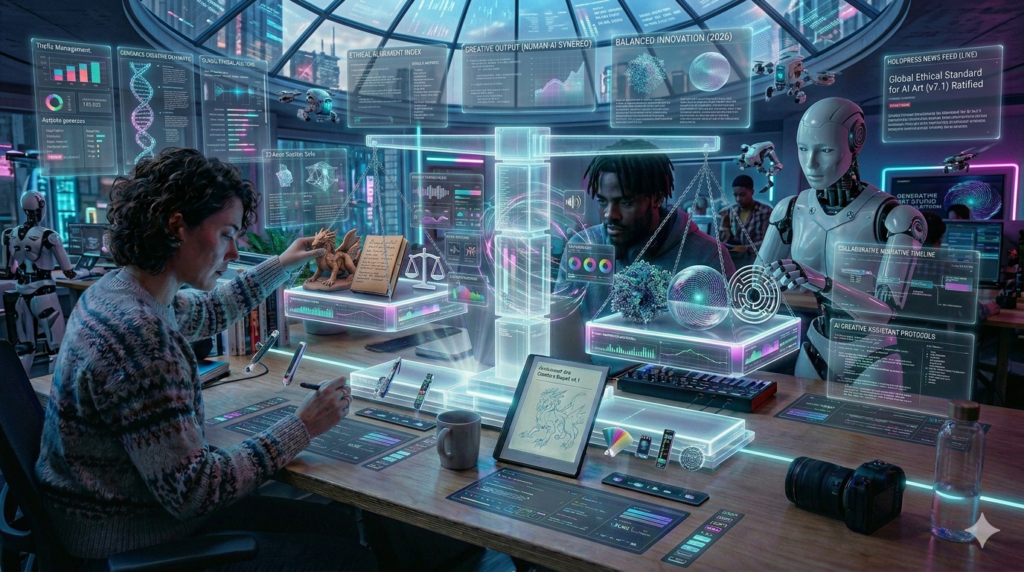
Why Human Creativity Will Always Matter
No matter how advanced AI becomes, human creativity will always remain essential.
People connect emotionally with:
- Authentic stories
- Real experiences
- Human struggles
- Cultural identity
- Emotional truth
AI can imitate patterns, but it cannot genuinely experience life.
That is why human imagination, empathy, and emotional intelligence will continue to shape the future of art, storytelling, and innovation.
The creators who thrive in 2026 and beyond will not fear AI.
They will learn how to use it responsibly while preserving authenticity and originality.
Final Thoughts
Artificial Intelligence is fundamentally transforming the creative world in 2026. It is changing how humans write, design, compose music, edit videos, market products, and innovate across industries.
However, AI is not replacing creativity.
It is expanding human potential.
The future belongs to creators who understand how to combine:
- Human imagination
- Emotional storytelling
- Strategic thinking
- AI-powered efficiency
Understanding how AI is changing human creativity is now essential for businesses, creators, students, entrepreneurs, and professionals who want to succeed in the modern digital economy.
Human creativity remains the heart of innovation.
AI is simply becoming one of its most powerful tools.
Frequently Asked Questions
Is AI replacing human creativity in 2026?
No. AI is helping creators work faster and more efficiently, but human emotion, originality, and storytelling remain irreplaceable.
How AI is changing human creativity in marketing?
AI helps marketers generate personalized campaigns, automate content creation, analyze customer behavior, and improve advertising strategies.
Can AI create original art?
AI can generate unique outputs based on patterns and data, but human creativity still provides emotional depth and meaningful context.
Which industries are most affected by AI creativity?
Content creation, graphic design, music production, filmmaking, digital marketing, advertising, and education are among the most affected industries.
Why should creators learn AI tools?
Learning AI tools helps creators improve productivity, stay competitive, explore new creative possibilities, and adapt to future technological changes.